
THE ABRAHAMIC TWELVEFOLD: Authority, Anthropology, and Covenant
This course offers an intensive, cross-tradition analysis of the structural relationship between authority, anthropology, and covenant in the Jewish, Christian, Islamic, and Persian intellectual worlds. It introduces the Twelvefold—a synthetic framework comprising three authority-forms (Patriarchate–Apostolate–Imamate) and nine anthropological dimensions (dust, breath, conscience, memory, law, liturgy, suffering, leadership, hope). Through close reading of core texts in the Tanakh (Genesis, Psalms, Ecclesiastes), New Testament (Romans, 1 Corinthians, Hebrews), Qur’an (Surahs 2, 20, 55), classical tafāsīr, patristics, rabbinic midrash, and Persian mystical poetry (Saʿdī, Hafez, Rūmī, ʿAṭṭār), the course develops a comparative anthropology grounded in mortality as first principle.
Students examine mortality as a generator of wisdom (Judaism), transformation (Christianity), accountability (Islam), and illumination (Persian tradition). The medieval academic hymn Gaudeamus Igitur is treated as a vernacular articulation of mortality-aware learning, supporting the course’s interpretation of the academy as a “fourth sanctuary” within Abrahamic civilization.
The Twelvefold is then applied to contemporary issues: interpretive authority, community formation, interreligious ethics, and eschatological hope in late modernity.
The course equips students with advanced methodological tools—philology, hermeneutics, phenomenology, and comparative theology—preparing them for research or leadership roles requiring sophisticated understanding of Abrahamic thought, cross-tradition reasoning, and covenantal anthropology.
Course Timings
Tuesdays, 16:00 UTC
Register by
September 1, 2026
Course Fee
100 €
Curriculum
- THE ABRAHAMIC TWELVEFOLD
Imamate · Apostolate · Patriarchate
A Triadic Genealogy of Mediation, Election, and Witness
This triadic structure becomes the grammar of Abrahamic mediation, the way the three great traditions articulate:
- continuity (succession and transmission)
- authority (interpretive, juridical, charismatic)
- witness (covenantal, ethical, eschatological)
The Core Principles of the Twelvefold:
- Succession
- Mediation
- Eschatological Orientation
- Anthropology of Vocation
II — THE ABRAHAMIC TWELVEFOLD
Triadic Map of Sacred Mediation
III — The Abrahamic Human: Image, Likeness, Khalifa
- The human as vicegerent, priest, witness
I V— Abrahamic Covenant & Scriptural Anthropology
- Covenant as testing (Nissayon), ṣabr, maqām
V — Death, Resurrection, and the New Creation
- The human being as resurrection-oriented creature
V I— Humanity in the Anthropocene: Dominion and Misrule
- Inner ecology → outer ecology; heart as the first ecosystem
VII — Kosmos and Khalifa: The Human Being as Successor & Image of God in an Age of Transhumanism
The Human Being as Successor & Image of God in an Age of Transhumanism
Prerequisites and Required Background
Preparatory Reading / Materials
No extensive preparatory reading is required in order to participate fully in the course. However, for those who wish to arrive with a shared conceptual vocabulary, the following short texts are recommended but not mandatory:
Foundational Scriptural Selections (any translation acceptable):
- Genesis 1–2 (creation, image, male and female)
- Genesis 12; 15; 17 (Abrahamic covenant)
- Psalm 8 (human dignity and vocation)
- Daniel 7 (humanity and dominion in apocalyptic perspective)
- 1 Corinthians 15 (resurrection and new creation)
- Qur’an 2:30–38; 3:67; 21:107 (khalīfa, Abraham, mercy to the worlds)
Optional Orientation Reading (short, accessible):
- Abraham Joshua Heschel, Who Is Man? (selections)
- N. T. Wright, Surprised by Hope (Introduction or Chapter 1)
- Seyyed Hossein Nasr, Religion and the Order of Nature (Introductory chapter)
All essential texts and conceptual frameworks will be introduced carefully during the lectures themselves. No participant will be disadvantaged by not completing the optional readings.
Prerequisites / Accessibility
This course is open to the general public and does not require formal prior training in theology, religious studies, or philosophy.
That said, the course is substantively rigorous and will engage:
- Scriptural texts (Hebrew Bible / New Testament / Qur’an)
- Comparative theology
- Philosophical anthropology
- Ethical and ecological questions in the contemporary world
Participants should be comfortable with sustained listening, reflection, and conceptual discussion. Technical terms will be explained as they arise, and the course is designed to be accessible to thoughtful non-specialists as well as advanced readers.
Primary Target Audience
The course is designed for a broad but focused audience, including:
- Graduate students and advanced undergraduates in theology, religious studies, philosophy, ethics, or related fields
- Educators, clergy, and religious leaders seeking deeper Abrahamic and interfaith grounding
- Policy thinkers, NGO leaders, and cultural leaders working at the intersection of religion, ecology, human dignity, and technology
- Scholars and professionals concerned with the Anthropocene, artificial intelligence, and transhumanism from a humanistic or theological perspective
- Thoughtful members of the public with a serious interest in Abrahamic traditions, human destiny, and the future of humanity
While the course draws on advanced scholarship, it is intentionally structured to foster shared inquiry across disciplines, traditions, and levels of expertise.
Target group
This course is open to a wide and diverse audience, including:
🎓 Academics & Researchers
📘 University & Graduate Students
📘 Interested laypersons
General info
Subject: THE ABRAHAMIC TWELVEFOLD: Authority, Anthropology, and Covenant
Language of instruction: English
Length: 10 sessions
Contact hours: 10
Session Timing
Time: 16:00 UTC
London: 17:00 (BST)
Please check your local time, as daylight-saving changes may apply.
Lecturer

Dr. Kurt Anders Richardson
Don't miss this unique opportunity to learn from a leading scholar in the field.
Frequently Asked Questions (FAQ)
What is the weekly course?
A Weekly Live Course is a general educational program open to anyone interested in the subject. Each course includes one live online session per week and runs throughout an academic term.
When does the course take place?
The course will run from September 8, 2026.
How long is the course and each session?
The course consists of 10 weekly sessions, and each session lasts 60 to 75 minutes, depending on the instructor’s plan.
Will the lectures be recorded and available for viewing after the live sessions?
Yes, all sessions are recorded and will be made available for viewing after they take place.
What is the cost of the course?
The course fee is 100 Euro.
How can I contact you if I have further questions?
You can email us at info@hikmat-ins.com.
Is installment payment available?
Yes. Installment payment is available for participants who register for more than two courses in the same academic term.
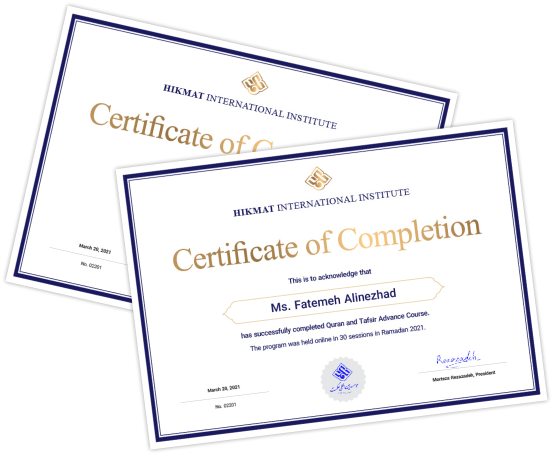
Certificate of Completion
For any questions, email us at info@hikmat-ins.com or message us on WhatsApp at +1 (778) 886 9819.