
Palaces of Wisdom
A Multi-Perspective Journey into Islamic Philosophy from Outside In
This course is deliberately structured like concentric circles of engagement:
– Outer Circle: Accessible to complete beginners through narrative, metaphor, and historical context
– Middle Circle: Engaging for intermediate learners through conceptual frameworks and comparative analysis
– Inner Circle: Challenging for advanced participants through direct engagement with primary texts and philosophical argumentation
The course will contain elements for all three circles simultaneously.
You don’t need a degree in philosophy. You just need curiosity and courage to think deeply.
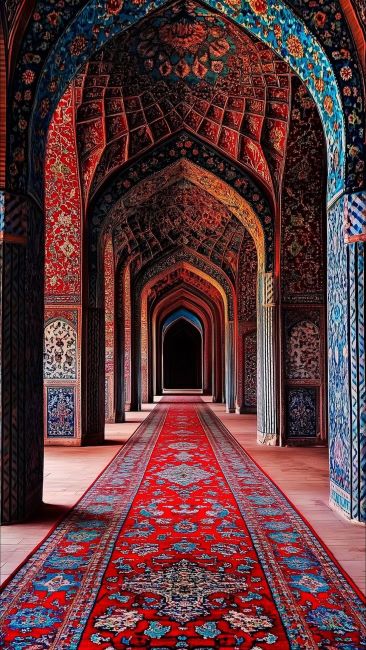
The palace has stood for centuries. Now it’s your turn to walk its halls!
Registration is not yet open. Please sign up in the form below to be notified when registration begins.
Course Dates
…, 2026
Registration Deadline
…, 2026
Scholarship
Partial scholarships available
Course Vision & Unique Approach
The Double-Lens Methodology: This course employs what we call “The Architectural Dialectic”– a two-phase engagement with Islamic philosophy:
- 1. The Exterior Gaze: We walk around the palace, observing it from different vantage points. Each perspective reveals different facets, shadows, and reflections. We ask: What does this palace (building?) look like from here? What function does it serve for this observer?
- The Interior Tour: We step through the threshold into corridors and rooms, where philosophical conversations have been happening for centuries. Here we don’t just study and describe philosophy – we do philosophy alongside Muslim thinkers, treating their questions as our questions, their problems as living problems.
Instructor’s Philosophical Commitment
This course operates on three pedagogical principles:
- Philosophy as Practice: We don’t just learn about philosophy; we practice philosophizing.
- Tradition as Conversation: Islamic philosophy is not a museum exhibit but a living conversation we join.
- Understanding as Transformation: Engaging with these ideas should change how we think, not just what we know.
Course Structure
PART I: Approach, Walking Around the Palace
- Standing at the Gates – What IS Islamic Philosophy?
- Beyond “Islam” and “Philosophy”: Defining Our Terrain
- Deconstructing the terms “Islamic,” “Philosophy,” and their problematic union
- The palace metaphor explained: Why architecture? Why a palace?
- The Three Myths we need to dismantle:
- The myth of Islamic philosophy as merely “Greek philosophy in Arabic”
- The myth of inevitable decline after the “Golden Age”
- The myth of philosophy vs. religion as simple opposition
- The Historian’s Vista – How Have We Told This Story?
- The Palace Through Time: Competing Narratives
- Four historiographical lenses:
- The Orientalist Narrative: Philosophy as foreign import that “died” with Averroes
- The Traditionalist Narrative: Philosophy as eternal wisdom within Islamic revelation
- The Revisionist Narrative: Philosophy as continuous, adaptive tradition
- The Post-Colonial Narrative: Philosophy as contested cultural territory
- The Ideological Prism – What Does This Palace DO?
- Functional Architectures: Philosophy as Theological, Social, Spiritual Tool
- Islamic philosophy as:
- Defense of religious orthodoxy (or challenge to it)
- Spiritual discipline or common discourse
- Scientific ground framework
- Cultural identity marker
- The Geographic Compass – Where is This Palace Located?
- Cartographies of Thought: From Spain to Southeast Asia
- Moving beyond the “Arab-Persian” axis:
- Philosophical traditions in Andalusia, West Africa, Ottoman lands, Mughal India, Malay world
- The Silk Roads of ideas: Transmission, translation, transformation
- The Contemporary Mirror – Why Does This Palace Still Matter?
- Echoes in Modernity: Islamic Philosophy Today
- Resurgence in 20th-21st centuries: Traditionalists, reformers, postmodern readers
- Islamic philosophy in dialogue with:
- Modern science
- Continental philosophy
- Post-colonial theory
- Global philosophy movements
- Bridge to Part II: How exterior perspectives color our interior engagement
Interlude: Crossing the Threshold
Preparing for the Interior Tour: Philosophical Toolkit Workshop
– Basic logical concepts (necessary vs. contingent, essence vs. existence, etc.)
– Reading philosophical texts: Between literal meaning and conceptual content
– The art of philosophical questioning (Inquiry, Polemic, Skepticism, Dialectic, Critical Thinking)
PART II: Immersion – Halls of the Palace
- Three Main Halls of Any Philosophical Architecture:
- Ontology
- Epistemology
- Ethics or Value Theory
- The Hall of Mirrors: Islamic Epistemology
- Realism, Idealism, Skepticism
- Sources and Limits of Human cognition
- Unveiling (Kashf) and Contemplation (Fikr)
- Metaphysics: battleground of endless controversies
- Main Hall: Ontology
- Encounter with being qua being
- Being and Quiddity
- Three big topics: God, Man, Universe
- God
- Question of the Arche and the Existence of God
- Eternal and Temporal dialectic
- Unity and Plurality
- Man
- Self-reflection and Object/Subject Dialectic
- Mind/body dialectic
- Eternality of the soul
- Absurdity and Meaningfulness, story of human life
- Universe
- Alam and Alim, different worlds and their distinctions
- Material and Immaterial dialectic
- Limits of Matter
- Hall of Values
- Ethics
- Culture
- Politics
- God
Returning to the Courtyard – Integration and Synthesis
– Revisiting our initial perspectives with new understanding
– Islamic philosophy as living tradition: Where do we go from here?
– Personal synthesis: Participants share their “map” of the palace
– Final Exercise: Each participant designs their own “room” – a philosophical question they would add to the tradition
Accessibility Note
The palace has many doors: Participants enter where they can and progress at their pace. Complete beginners should focus on the narrative and conceptual frameworks. Advanced participants will find challenging material in primary texts and philosophical problems. The magic happens in the exchange between these levels – beginners asking fresh questions, advanced participants refining their understanding through explanation.
Assessment & Engagement
Participants can choose their level of engagement:
1- Explorer: Attend sessions, participate in discussions
- Cartographer: Keep a philosophical journal, map connections
- Architect: Final synthesis project – essay, creative work, or lesson plan
Final Project:
Share your suggestions for an engaging palace tour. Finalize the plan with the instructor, and you’ll be ready to begin! A few suggestions to get you started:
– Design a “museum exhibit” on one Islamic philosopher
– Create a dialogue between an Islamic philosopher and a modern thinker
– Write a philosophical letter to one of the thinkers studied
– Develop a lesson introducing Islamic philosophy to a specific audience
– …
Required & Recommended Texts
Primary Source Anthologies:
Khalidi, M.A. (ed.) Medieval Islamic Philosophical Writings (Cambridge)
Nasr, S.H. & Aminrazavi, M. (eds.) An Anthology of Philosophy in Persia (2 vols, I.B. Tauris)
Jon McGinnis and David C. Reisman, Classical Arabic Philosophy an Anthology of Sources
Secondary Texts
Leaman, O. Islamic Philosophy: An Introduction
Adamson, P. Philosophy in the Islamic World
Griffel, F. The Formation of Post-Classical Philosophy in Islam
A History of Islamic Philosophy by Majid Fakhry
Islamic Philosophy from Its Origin to the Present by Seyyed Hossein Nasr
Islamic Philosophy A–Z by Peter Groff
The Cambridge Companion to Arabic Philosophy – edited by Peter Adamson and Richard C. Taylor
The Oxford Handbook of Islamic Philosophy – edited by Khaled El-Rouayheb and Sabine Schmidtke
And …
Target group
This course is open to a wide and diverse audience, including:
🎓 Academics & Researchers
🕌 Religious Leaders & Faith-Based Practitioners
📘 University & Graduate Students
🌍 NGO Professionals & Peacebuilders
🗣️ Educators & Dialogue Facilitators
General info
Subject: THE ABRAHAMIC TWELVEFOLD: Authority, Anthropology, and Covenant
Language of instruction: English
Length: 10 sessions
Contact hours: 10
Certificate: Academic
Session Timing
Los Angeles (PST):
New York (EST):
London (GMT):
Tehran:
Lecturer
Dr. Hossein Latifi
Dr. Hossein Latifi is a scholar of western philosophy and Islamic Studies, holding a Ph.D. in Philosophy from the University of Tehran and advanced seminary training in Qom. He has extensive teaching experience across international institutions, specializing in Islamic philosophy, theology, and law, and has contributed to academic publications and translations in these fields.
Don't miss this unique opportunity to learn from best scholars in the field.
Frequently Asked Questions (FAQ)
What is the International Intensive Academic Course on Interfaith Dialogue?
The course is a university-level program designed for students and academics interested in enhancing their understanding of Interfaith Dialogue. It consists of 13 sessions covering various aspects of the subject.
Who is the target audience for this course?
The course is aimed at professors, researchers, religious leader, university students in religious studies, Islamic studies, philosophy, and anyone with a strong interest in the topic who has a good command of English.
When does the course take place?
The course will run from January 5-23, 2026.
How long is each session?
Will the lectures be recorded and available for viewing after the live sessions?
What is the cost of the course?
The course fee is 700 Euro. However, you can take advantage of our scholarship opportunity.
Is there any schilarship available?
How can I contact you if I have further questions?
You can email us at info@hikmat-ins.com.
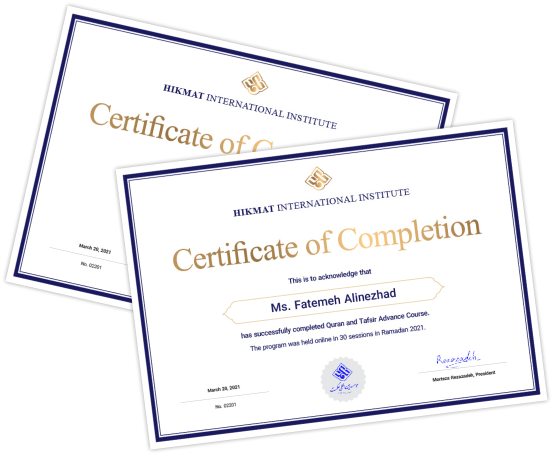
Certificate of Completion
For any questions, email us at info@hikmat-ins.com or message us on WhatsApp at +1 (778) 886 9819.