
Ijtihad, Religious Authority and System of Clergy in Shi'i Islam
This course offers an in-depth exploration of the dynamic framework of religious authority that has guided the Shi’i world for centuries. From the foundational era of the Prophet and the Imams to the development of scholarly leadership during the occultation period, we will trace the historical evolution of the clerical system.
Throughout this course, we will demystify the rigorous academic and spiritual journey of becoming a faqih and a Marja’ al-Taqlid. You will gain a clear understanding of how Islamic jurisprudence (Usul al-fiqh) is applied, exploring the traditional sources of the Quran, Sunnah, Reason, and Consensus. By examining real-world case studies, the daily functions of the Hawzas (seminaries) in pivotal centers like Najaf and Qom, and the modern challenges facing Islamic centers today, you will leave this course with a comprehensive understanding of how Islamic law adapts to the
Course Dates
…, 2026
Registration Deadline
…, 2026
Scholarship
Partial scholarships available
Course Outline
- Concept and History of Authority
- a. The Definition of Religious Authority
- b. Historical Evolution:
- i. The time of the Prophet
- ii. The era of the Imams
- iii. The Occultation Period: The emergence of scholarly authority
- Functions and Position of the Clergy
- a. Issuing Fatwas in religious affairs
- i. Traditional questions on religious subjects
- ii. Modern and emerging new issues
- b. Directing the educational system of the Hawzas
- i. Educational administration and curriculum
- ii. Financial management (distribution of alms and religious taxes)
- c. Social and community leadership
- i. Preaching and educating the public
- ii. Spiritual and moral guidance
- iii. Directing international Islamic centers, institutes, and mosques
- d. The societal position and influence of the Marja’
- The Journey of Fulfillment
- a. The academic and spiritual process of becoming a faqih (mujtahid)
- b. The elevation to becoming a Marja’
- c. The layperson’s process of choosing a Marja’ (Taqlid)
- The Mechanics of Ijtihad (Theory to Practice)
- a. Traditional Sources of Law
- i. Quran
- ii. Sunnah
- iii. Reason (‘Aql)
- iv. Consensus (Ijma’)
- b. Methodology
- i. Usul al-fiqh (Principles of Jurisprudence)
- c. Interactive Case Study
- i. Step-by-step investigation of a modern fiqhi question applying the sources and methods learned above
- Centers of Scholarly Learning (Hawzas)
- a. Najaf
- b. Qom
- c. Other historical and regional centers (e.g., Isfahan, Mashhad, and local network schools)
- The Current Era: Modern Adaptations and Challenges
- a. The Digital Marja’: Online Istifta networks, social media, and global communication
- b. The Diaspora Experience: How international Islamic institutes bridge the geographic gap between the Hawza and global communities
- c. Evolving Governance: Wilayat al-Faqih and systemic structural developments in clerical authority
Required & Recommended Texts
Target group
This course is open to a wide and diverse audience, including:
🎓 Academics & Researchers
🕌 Religious Leaders & Faith-Based Practitioners
📘 University & Graduate Students
🌍 NGO Professionals & Peacebuilders
🗣️ Educators & Dialogue Facilitators
General info
Subject: THE ABRAHAMIC TWELVEFOLD: Authority, Anthropology, and Covenant
Language of instruction: English
Length: 10 sessions
Contact hours: 10
Certificate: Academic
Session Timing
Los Angeles (PST):
New York (EST):
London (GMT):
Tehran:
Don't miss this unique opportunity to learn from best scholars in the field.
Frequently Asked Questions (FAQ)
What is the International Intensive Academic Course on Interfaith Dialogue?
The course is a university-level program designed for students and academics interested in enhancing their understanding of Interfaith Dialogue. It consists of 13 sessions covering various aspects of the subject.
Who is the target audience for this course?
The course is aimed at professors, researchers, religious leader, university students in religious studies, Islamic studies, philosophy, and anyone with a strong interest in the topic who has a good command of English.
When does the course take place?
The course will run from January 5-23, 2026.
How long is each session?
Will the lectures be recorded and available for viewing after the live sessions?
What is the cost of the course?
The course fee is 700 Euro. However, you can take advantage of our scholarship opportunity.
Is there any schilarship available?
How can I contact you if I have further questions?
You can email us at info@hikmat-ins.com.
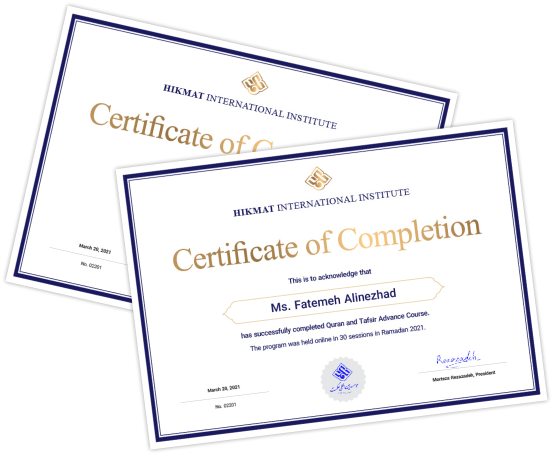
Certificate of Completion
For any questions, email us at info@hikmat-ins.com or message us on WhatsApp at +1 (778) 886 9819.